
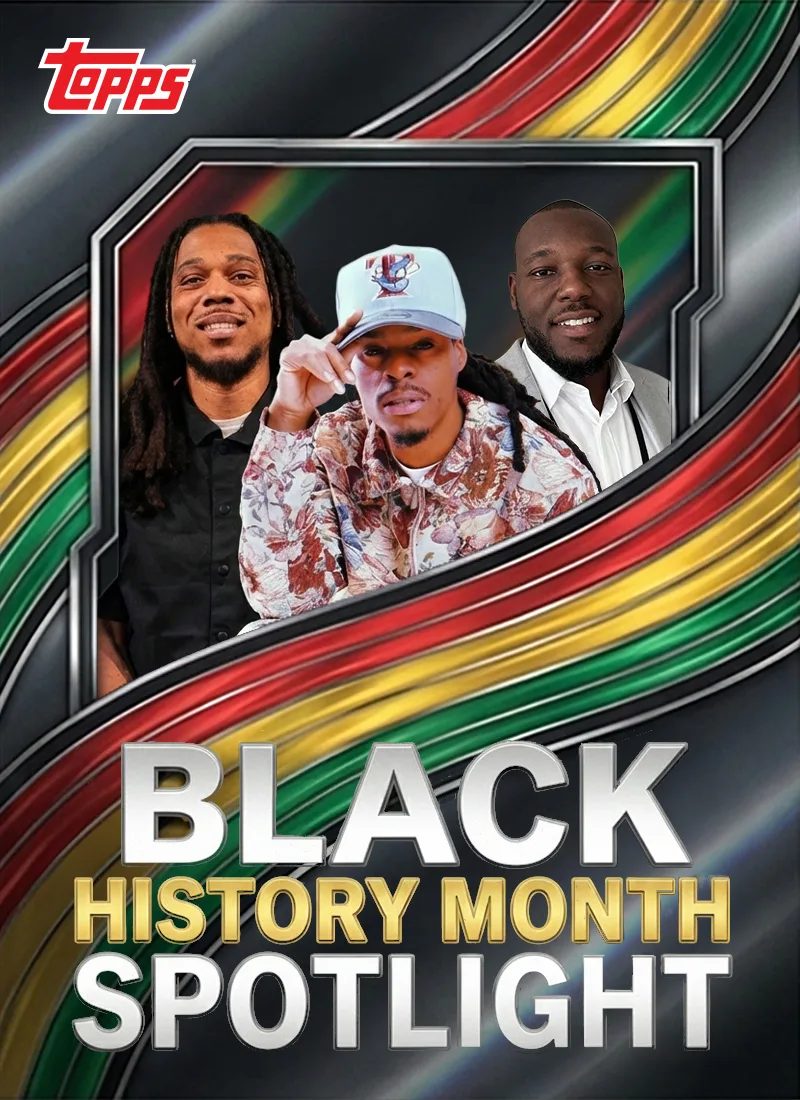
A Conversation With Three Hobby Game-Changers
The Hobby has always preserved history. It has preserved the rise of icons and the turning points of seasons. It has preserved statistics, signatures, rookie debuts, and championships. For decades, those stories lived almost exclusively on cardboard. You pulled them from packs, studied them at kitchen tables, slid them into binders, and hoped they would hold their meaning over time.
Today, The Hobby still preserves history, but it also creates it in real time. Sports card content creators are transforming the modern Hobby by influencing product demand, shaping perception through livestream breaking, and expanding representation. The Hobby is no longer just about what’s printed on the card. It’s about who’s holding the mic when that card is revealed, who frames the moment, and who makes collectors feel like they belong in the room.
Creators like Doctor Collectible (@doctorcollectible), Chuck of Cult of Wax West (@cultofwaxwest), and Cam Turney of We The Hobby (@cam_wethehobby) are redefining how collectors experience cards — both online and in person. They operate in different lanes, but they are shaping the same moment.
Sports card content creators are transforming the modern Hobby by influencing product demand, shaping perception through livestream breaking, and expanding representation. Creators like Doctor Collectible, Chuck of Cult of Wax West, and Cam of We The Hobby are redefining how collectors experience cards — both online and in person.
Passion Before the Platform
Doctor Collectible remembers hearing his father shout from the living room when Michael Jordan secured his sixth championship. “He did it again. He did it again.” That excitement pulled him toward brown paper bags filled with carefully stored cards, where he found a young Kobe Bryant in purple and gold. “It was just this kid with the ‘fro,” he recalls. “Something excited me with the Lakers colors. That whole purple and gold.”
The collectible itself became the classroom. “Learning the statistics on the back of the cards. Not watching ESPN, but being able to keep up with the player through the card itself.” The Hobby was education before investment; connection before currency.
Cam Turney’s introduction came through observation. He watched his older brother keep binders “perfectly organized,” studying the care and discipline of collecting long before he understood value. He would sit in his own room flipping through cards, convinced he was building the best collection in the world. It was never about hype. It was about meaning. Years later, that instinct still shapes him.
“My personal collection is not the most hype players,” he explains. “I PC like Warren Moon. I PC like Cobi Jones.” Those names reflect memory, representation, and identity.
Chuck’s relationship with The Hobby returned through hustle. In college, he flipped sneakers and learned resale culture firsthand. When inventory became overwhelming, he pivoted to collectibles. During the pandemic, cards resurfaced. “It kind of brought me back to my childhood,” he says. Opening packs and sorting stacks reconnected him to an earlier version of himself. The Hobby doesn’t just preserve sports history, but that young version of yourself who just discovered the passion to collect.
When the Hobby Became Personal
After moving to Atlanta to pursue dance and acting, Doctor Collectible found himself facing real hardship while working multiple jobs, trying to regain stability.
“I literally can remember being in my car during the winter trying to figure out what am I doing with myself,” he says. Among the few possessions that survived a personal tragedy were the Kobe cards his father had sent him over the years. When Kobe passed and values surged, he faced a painful decision. “I said, ‘Wow, I think I’m gonna have to sell my childhood in order to get back on my feet.’”
That moment shaped the meaning behind Doctor Collectible. The “Doctor” represents study, mastery, and seriousness. He had always wanted a PhD. If he was going to carry that title, it would be in something he respected deeply and that helped him survive. He has described it as wanting to “medicate the Hobby.” To elevate the conversation. To treat collecting as discipline, not impulse.
“I wanted to collect,” he says. “I’m not in a hobby to always flip, because I had to flip my childhood.”
Before stepping into content creation, he spent time studying the space. “For a year I sat back and watched content and asked how I can be different,” he says. “I want to create content for the individual that’s at home, working a nine to five, who can’t make it to their own show.”
Content became a bridge.
Chuck’s pivot into breaking came from a different tension. After more than a decade in professional environments where he felt he had to be “corporate and political,” The Hobby offered freedom. “I feel like breaking and this hobby is one of the few places where you can actually be yourself,” he says. “I wanted to work in a place where I could just truly be myself and meet people and talk to people organically.”
He started breaking steadily, starting with baseball and soccer because basketball and football were too expensive to fund. Through repetition, study, and live engagement, he developed his voice. Breaking requires stamina, product knowledge, composure, and personality all at once. It’s performance layered with preparation.
Cam Turney’s role evolved quickly. Joining We The Hobby placed him on one of the largest stages in the space.
“My whole thing was to build the channel, get it to a point where it’s sustainable, add more on-air personalities, and keep growing,” he says. That meant consistency; carrying long streams; representing major drops; hosting in front of packed rooms at the National. It meant announcing Tom Brady on stage and streaming with NBA players, ripping cards alongside Andre Iguodala. It meant anchoring the room while making it feel accessible.
Authenticity and Perception in The Hobby
Chuck has noticed that feedback can shift depending on what he breaks. “It’s more critical. When you get to the sports, people expect you to know a little bit more, and because of how I look possibly, a little bit more critical.” He follows soccer deeply, yet assumptions linger. “I think there’s definitely a preconceived notion that we only know basketball and football,” he says. His answer is every time consistency and knowledge — showing up prepared until the expectation shifts.
Doctor Collectible understands perception in physical spaces. “When I walk in rooms where we are not represented, I’m trying to represent us,” he says. Visibility becomes layered. You are not just present; you are signaling possibility.
Cam Turney has experienced perception live. “There’s definitely still some ignorance out there. On stream, somebody would come on and start putting racial slurs, and we just boot them out.” Livestreams amplify both support and hostility. But they also normalize presence.
“We now have representation in this space on one of the biggest platforms,” he says.
Representation here is not symbolic. It is operational. It shapes who feels welcome when they log in.
Building Beyond the Break
The power across all three of these creators is not just visibility, but intention.
Doctor Collectible talks about ownership with clarity. Start the LLC. Protect your ideas. “If you start a business, you can be treated as a business,” he explains. Longevity means building revenue without constantly selling the cards you love.
Chuck emphasizes freedom with preparation. Be yourself, but know your craft. Knowledge sustains credibility.
Cam Turney looks toward history and future access. “There are still some things, first Black person to do this, first African American to accomplish this. I think there’s history that can still be revealed.” Collect what speaks to you. Study it. Understand it.
Content creation in The Hobby is no longer peripheral. It is infrastructure. It shapes who feels informed, welcomed, and seen. Black athletes have long defined some of the most iconic cards in The Hobby. Now, Black creators are helping define how The Hobby feels in real time — how it sounds, welcomes, thrives, and evolves.
The Hobby has always preserved history. What’s happening now is about expanding who gets to help tell it. And when more voices hold the mic, the story does not fragment.
It deepens.
Topps Black History Month Spotlight FAQ
- What does a sports card content creator do?
- A sports card content creator produces livestreams, product breaks, interviews, and Hobby coverage across digital platforms. They influence product demand, educate collectors, and shape how releases and events are perceived.
- How does livestream breaking affect card values?
- Livestream breaking can create immediate visibility for specific players or parallels. When a card trends during a live stream, collector demand may rise quickly, influencing short-term market movement.
- Why is representation important in The Hobby?
- Representation expands who feels welcomed in collecting spaces. When diverse creators are visible on major platforms, it signals inclusion and broadens community participation.
- Can you build a business through sports card content?
- Yes. Many creators form LLCs, monetize livestreams, partner with platforms, and build brand equity. Sustainability requires product knowledge, consistency, and audience trust.
Key Facts:
- Livestream breaking can influence demand within minutes.
- Content creators now shape product perception as much as manufacturers.
- Representation in digital spaces affects community growth.
- Breaking requires knowledge, stamina, and on-air presence.
- The modern Hobby blends cardboard history with real-time storytelling.
More Topps Black History Month
-
Black History Month Spotlight: Educating The Hobby
-
Black History Month Spotlight: Fanatics Collectibles Production Coordinator Lindsey Bethel
-
The History of Black Athletes in Topps
-
Black History Month Spotlight: Director, Social Media at Fanatics Sportsbook Emery Barnes
-
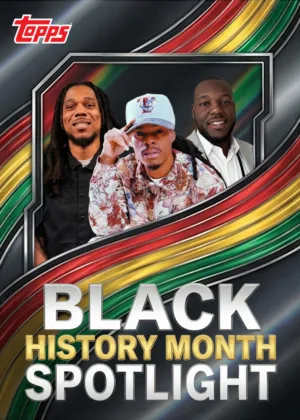
Black History Month Spotlight: Representation in Content Creation
-
Topps Baseball at 75: The Legacy of Black Celebrities in Allen & Ginter
-
Black History Month Spotlight: Topps Events Marketing Manager Carley Fort


