
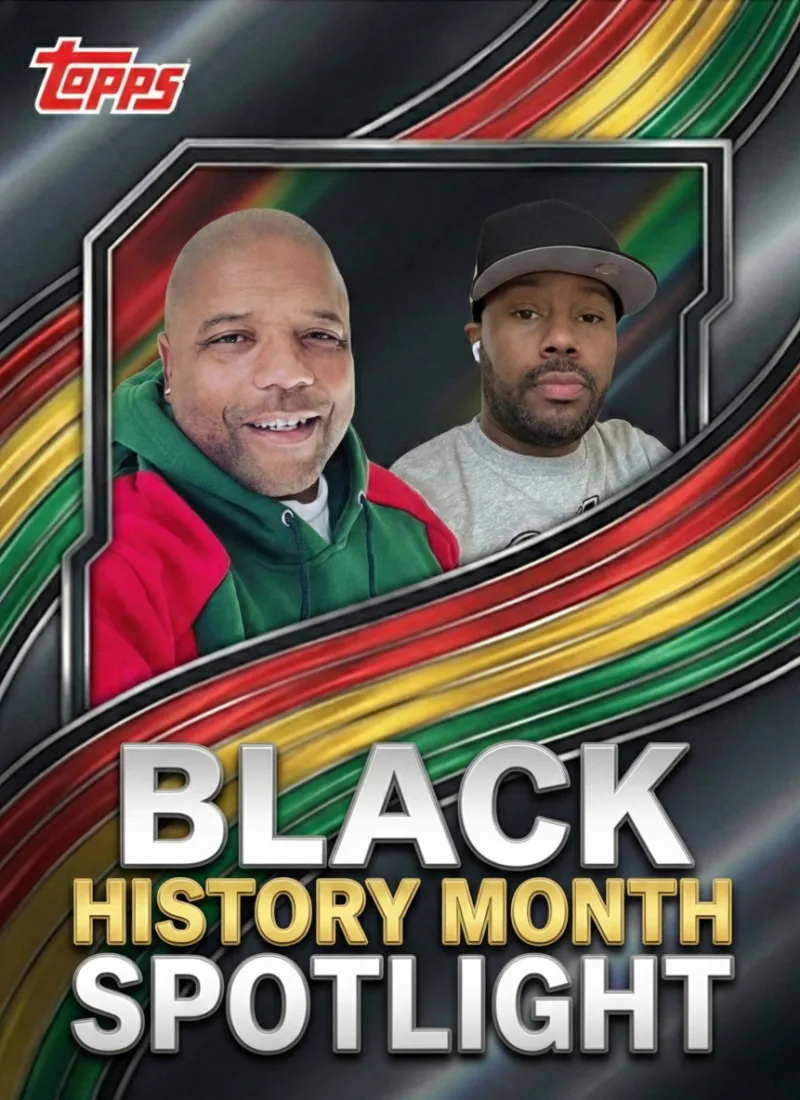
Lawd Prizm and Prizm Gawd Redefine Black Leadership in The Hobby
The trading card Hobby has never lacked Black collectors. The passion has always existed, passed down through generations and shared in familiar spaces. Packs were opened at kitchen tables. Arguments over players and eras filled barbershops and living rooms. Cards were traded at school, at games, and in neighborhoods where sports and culture were inseparable. Black collectors have always been part of The Hobby’s lifeblood.
What The Hobby has historically lacked is Black ownership. Ownership of card shops. Ownership of platforms. Ownership of the spaces where access is granted, relationships are built, and opportunity is created. Participation has never been the issue. Power and visibility have been.
Two Black owners, working in different lanes but toward the same goal, are helping change that reality. Ronnie Ford, aka Lawd Prizm, owner of LAWD PRIZM Sports Cards and Memorabilia in Riverside, California, and Raphael Mosley, aka Prizm Gawd, founder of Culture Collision, represent two essential pillars of ownership in The Hobby. One is rooted in the neighborhood and built on daily trust. The other operates on a national stage, focused on scale, visibility, and cultural presence. Their stories are different, but together they illustrate why ownership matters and what it looks like when it is built with intention.
Lawd Prizm: Building a Community Shop From Purpose
Lawd Prizm’s connection to The Hobby began long before owning a storefront was ever a consideration. “I probably started collecting in like 1977,” he said. “I remember getting Tony Dorsett cards. I used to live in LA and the police department used to hand out Dodger cards. I was probably seven years old.” Those early moments were rooted in joy and community, not value or profit, and collecting stayed with him for decades.
Before becoming a shop owner, Lawd Prizm spent nearly three decades shaping young lives as a high school basketball coach. He coached for 27 years across Los Angeles and Riverside, including stops at Washington High School, Augustus Hawkins, and Corona Santiago. Teaching, mentoring, and building confidence were central to his career, and those same instincts would later define how he approached ownership in The Hobby.
Opening a card shop was never the plan. That changed after his son suffered a traumatic brain injury while playing high school football. “When he came out of his coma, they thought he wasn’t going to be able to learn,” Lawd Prizm said. “But God is better than that. He’s about eighty five to ninety percent of what he was.” As his son recovered, Lawd Prizm began thinking differently about stability, opportunity, and how to build something meaningful that could also provide a future.
At the same time, his experiences visiting card shops left him increasingly frustrated with what The Hobby had become. “They wasn’t about the Hobby,” he said. “It was more about how much money they could make. You’d go in and they wouldn’t even talk to you until you was ready to spend money.” That frustration came to a head when he purchased a damaged Hobby Box and the shop refused to take responsibility. “That kind of pissed me off,” he said. “And then I said, you know what, let me open up a shop.”
Within a week, he secured a small space, filed an LLC, and stocked shelves using his personal collection and whatever product he could find at Target, Walmart, or wherever cards were available. LAWD PRIZM’s Sports Cards and Memorabilia was built without shortcuts, industry backing, or guarantees. It was built with the same principles he carried as a coach: accountability, honesty, and care for the people walking through the door.
Ownership as Atmosphere and Trust
From the moment customers walk into LAWD PRIZM, the philosophy is intentional. “I like people to come in and feel like they sittin’ in the living room or the garage watching the game,” Lawd Prizm said. “You’re not going to walk in and not be greeted.” The shop is designed to feel familiar rather than transactional, a space where collectors are welcome whether they are buying or just talking.
That atmosphere shapes how people move through the space. Collectors do not simply shop and leave. They stay. They watch games, ask questions, and learn. Lawd Prizm takes the time to explain the difference between low end, mid tier, and high end products because, as he puts it, “A lot of people don’t have information. You gotta sit down and talk to them.” On weekends, he stays until the last customer leaves, reinforcing that the relationship matters more than the sale.
Because of that trust, moments have room to grow. At LAWD PRIZM Sports Cards and Memorabilia, big moments are part of the rhythm of the shop. They aren’t rare, once-in-a-year occurrences. They happen in real time, in front of other collectors, and they stop the room when they do. One day it’s a gold Messi redemption that comes back graded PSA 10. Another day it’s a young collector pulling a Julio Rodríguez autograph and screaming as his mom scrambles to record the moment, already knowing it will live on long after the card is sleeved.
What ultimately defines LAWD PRIZM Sports Cards and Memorabilia isn’t the hits themselves. It’s the trust behind them. “When they come to Lawd Prizm, them boxes ain’t tampered with,” he said. “If autos supposed to be in there, it’s in there.” In a Hobby where skepticism is common and bad experiences spread fast, that transparency matters. Customers know they’re getting exactly what they paid for, and that confidence keeps them coming back. Over time, shared moments and consistent honesty turn customers into regulars, and regulars into community. That trust is the foundation of ownership.
That sense of responsibility became even clearer at a card show in Las Vegas, when Lawd Prizm learned something that reframed everything. “They told me, you’re one of only two Black owners of a brick and mortar shop,” he said. “I had to step back and say, oh man, I got a responsibility now.” Ownership, for him, now means visibility, mentorship, and building pathways for others. “If it’s only two of us,” he said, “then we gotta do some recruiting.”
Prizm Gawd: Scaling Ownership Through Culture Collision
While Lawd Prizm represents ownership at the community level, Prizm Gawd represents ownership at scale. Like many collectors, Prizm Gawd’s journey began simply. “I was just a collector, man,” he said. “I bought cards I liked. Then I realized I could make money in this space.” Over time, he explored nearly every lane in The Hobby, from buying and selling to retail and breaking, gaining a broad understanding of how the ecosystem works.
That experience revealed a larger gap. Major card shows existed, but few reflected the culture of the collectors who power The Hobby. Representation was limited, especially at scale. That realization led to Culture Collision, which began in 2021 and is the first and largest Black-owned trading card trade show.
“We look at ourselves as one of the risk takers in this space,” Prizm Gawd said. “We don’t have the backing others have, so we have to be creative and try things other people aren’t willing to try.”
Culture Collision blends traditional card show infrastructure with live DJs, music, and cultural touchpoints that make the space feel familiar rather than intimidating. “For the most part, man, it’s the community,” he said. “It all boils down to that.” Ownership, for Prizm Gawd, is about visibility and legitimacy at the highest level. “We haven’t had representation of this magnitude,” he said. “People aren’t used to seeing people of color doing this on a high level.”
Fighting for Space and Building Anyway
Prizm Gawd is candid about the challenges that come with ownership in The Hobby. “Support can be inconsistent especially when you’re building something new independently,” he said. Despite that, Culture Collision continues to grow, expanding partnerships, launching traveling events like Just a Card Show, and drawing organic support from figures like Funny Marco, who attended simply to learn and support.
Behind the scenes, the business is run with his wife, Prizm Gawdess, and the work is deeply personal. “It is very hard,” he said. “But she is the heart and soul of the show. A lot of times I come up with ideas, but she always figures out a way to get it done.”
Ownership and the Next Generation
For both men, ownership is inseparable from responsibility. Prizm Gawd hopes young Black collectors and entrepreneurs see what is possible at scale. “I really hope Black people or people of color will see this as an opportunity they can be a part of,” he said. “That’s what’s benefited other people in this space for generations.”
Lawd Prizm sees that future walk through his shop every weekend. “We got kids that was five or six, now they ten, eleven, twelve,” he said. “They coming back telling us they going pro and telling us to hold their memorabilia.” Those moments are more than jokes or dreams. They are the first signs of belief taking root.
Black ownership in the Hobby is not about exclusion. It is about access. It is about trust. It is about representation where it has long been absent. It is about ensuring the next generation sees more than collectors who look like them. They see owners. They see builders. They see pathways that once felt closed.
Prizm Gawd & Lawd Prizm FAQs
- Why is Black ownership important in the trading card Hobby?
- Black ownership ensures collectors see themselves not just participating, but leading. It creates trust, cultural relevance, and long-term opportunity that has historically been missing despite strong participation.
- Who is Lawd Prizm in the card collecting community?
- Lawd Prizm is the owner of LAWD PRIZM Sports Cards and Memorabilia in Riverside, California, known for building a community-first card shop rooted in transparency and trust.
- What is Culture Collision?
- Culture Collision is the largest Black-owned trading card trade show, founded by Prizm Gawd, blending traditional card show infrastructure with music, culture, and community-focused experiences.
- How do Black-owned card shops impact collectors?
- They create welcoming environments, prioritize education, and foster long-term relationships rather than purely transactional interactions.
- What can new collectors learn from these owners?
- That ownership is possible, community matters, and the Hobby grows strongest when trust and culture are centered.
Key Facts
- Black collectors have always shaped the trading card Hobby
- Black ownership remains rare, especially at scale
- LAWD PRIZM represents community-rooted ownership
- Culture Collision represents national-scale visibility
- Ownership creates access, trust, and future opportunity
More Topps
-
Football and The Hobby
-
The Rise of Women’s Sports Trading Cards in The Hobby
-
75 Years of Topps Baseball Card No. 1
-
2025 Bowman Draft Baseball Prospecting Primer
-
Celebrating Topps Baseball Series 1 Cover Athletes Through the Years
-
A Savory Legacy: The Best Cheese-Themed Topps Cards
-
“The Holy Grail” — Chasing the 1961 Topps Dice Game


