
Building Access for the Next Generation
The Hobby has always been strongest where it was inherited. It flourishes in homes where binders are passed down from parent to child, where weekends meant card shows, where neighborhood shops became community anchors.
For many collectors, discovering cardboard was not a decision; it was simply present. But proximity is not universal. For countless communities, especially Black and Brown communities, that proximity never existed. There was no card shop on the corner. There was no generational collector in the household. There was no visible pathway from loving sports to participating in The Hobby. What existed instead was interest from a distance.
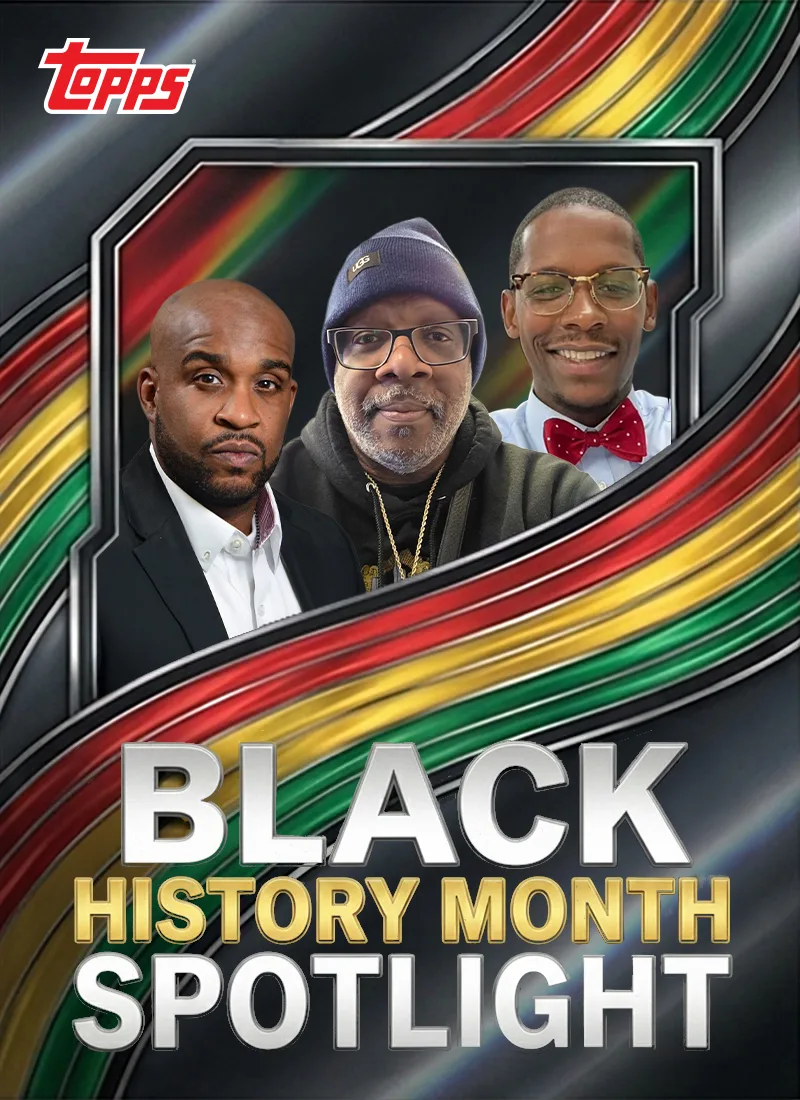
For Anthony Dovine, Samuel C. Evans, and Tyrone Miller, that distance was formative. Each of them entered The Hobby differently. Each built their identity within it through different means. What binds their stories together is both representation and reconstruction. They are not simply asking for a seat at the table — they are building tables where none existed before.
Anthony Dovine, Samuel C. Evans, and Tyrone Miller are expanding representation in The Hobby by creating intentional access points for Black and Brown collectors. Through youth programs, classroom integration, and national media presence, they are rebuilding proximity to sports card collecting in communities historically excluded from it.
The Pass-Down That Never Came
Anthony Dovine’s relationship with cardboard began later than he would have liked. “I was introduced to sport cards as a 33, 34-year-old grown man,” he says. “I went my whole youth not knowing anything about this.”
He did not miss The Hobby because he didn’t know what he was missing. But once he discovered it — once he felt the energy of opening a pack and understanding the ecosystem behind it — the absence became obvious. “When it was introduced to me, one of the first things out of my mouth was, man, it sucks,” he says. “Why didn’t someone show this to me when I was a kid?” That question did not fade. It became fuel.
Anthony’s answer to that absence is Rise Up, a program based out of Chicago that he has grown into one of the most intentional youth initiatives in The Hobby through his platform Dvine Warrior Brands (@dvine_warrior_brands). The program is not a marketing extension of his business, but a symbolic gesture layered onto an otherwise traditional dealer presence. It’s a financial and personal commitment rooted in the Chicago communities that he knows firsthand.
Every year at The National, the largest gathering in The Hobby, Anthony gives up booth space that could generate substantial revenue. Instead of maximizing profit, he fills that space with students from underserved and at-risk neighborhoods.
“I don’t bring cards to the show,” he says. “I bring kids. I bring futures. I am committed to the youth.” He funds the program himself, paying for backpacks, school supplies, and product. He gives up the ability to buy and sell at scale during one of the most profitable weekends in the calendar because he believes access must be intentional.
Rise Up didn’t begin as the immersive educational experience it is today. In its early form, it focused purely on joy. Kids ripped packs, reacted to autographs and parallels, and left with excitement. But Anthony quickly realized that excitement without education wasn’t enough. “I was just giving them the fluff,” he says candidly. “Open packs. Have fun. Go home.”
Now, the program is structured around immersion. Students watch real transactions happen. They see $5,000 and $10,000 deals unfold in real time. They learn to check comps, to understand value, to recognize that cardboard is not just nostalgia, but negotiation, discipline, and strategy.
“I want them to see the grit of it. The grind of it,” he says. “I want them to see that this is real. That you can build something from this.” The goal is not to turn every child into a dealer. The goal is to expose them to possibility and to make sure the next generation does not have to discover The Hobby at 34 and wonder why no one opened the door sooner.
Building Mirrors Inside the Classroom
Samuel C. Evans approaches the same mission from within a classroom. An educator in Philadelphia, Evans saw early that The Hobby could function as more than entertainment — it could be curriculum, and development.
“The Hobby is plentiful in negotiations, analyzing card data, thinking critically,” he explains. “It just made sense to bring my passion of collecting into my space as an educator.” For Evans, cardboard is not separate from education. It is layered into it. Through his brand #thehobbyexperience and his platform @thesprtzcardcoltr, he brings The Hobby to the forefront in schools and communities that have historically lacked access.
Evans understands that trading cards can teach transferable skills. Negotiating trades builds communication. Tracking player performance builds analytical thinking and data literacy. Managing a collection builds organization and financial discipline. But the deeper layer is representation. He describes certain communities as cardboard deserts — places where there is no local shop, no visible Hobby infrastructure, no easy entry point.
“They don’t have access to card stores within their proximity,” he says. So he becomes the bridge. Sometimes it begins with something simple: cards laid out on a desk, students gathering, conversations forming organically. “Next thing you know, you cultivate that cardboard ecosystem. You see kids who didn’t even know they were interested start to lean in.”
Evans speaks about mirrors and windows as a framework for belonging. “When kids have mirrors, they see people who look like them in spaces they’re intrigued about. They can go into those spaces and thrive.” He witnessed that transformation at the National while supporting Rise Up. Students who initially shielded themselves began to open up when they saw adults who looked like them navigating The Hobby confidently.
“They started to see like, ‘oh, this is a space I can thrive,’” he recalls. That shift from guarded to engaged is foundational. It creates emotional safety and room for curiosity. “It’s cool to be a nerd. It’s cool to have hobbies,” Evans says. “When Black and Brown kids see people who look like them thriving in this space, they’ll want to share their cardboard story too.”
But Evans pushes further than exposure. He asks structural questions. How can The Hobby think intentionally about equity and access? How can card stores exist in underserved areas? How can national initiatives reach community centers and schools in meaningful ways? Through #thehobbyexperience, he is not simply introducing kids to collecting. He is advocating for sustainable infrastructure that supports them long after the first pack is opened.
“We can’t just show up once,” he says. “We have to build something that stays.”
Taking The Hobby to the Pavement
Tyrone Miller’s lane is movement. As an on-air personality at Dave and Adams Sports Cards and a media presence who has served the tri-state area for years — including appearances on Central Jersey TV and Manhattan Neighborhood Network — Miller understands both storytelling and visibility. Before fully immersing himself in The Hobby, he had opportunities in traditional network media. He chose cardboard intentionally.
“I had a gig at a network, and I had this gig at Dave and Adams,” he says. “I took the Dave and Adams, and I’ve been off and running ever since.” He walked into the interview authentically. “If they’re going to take me, they’re going to take me as I am.”
Once inside The Hobby, he recognized something immediately: Entire communities that looked like his own were not consistently represented in card culture spaces. “As soon as I got here, I said, I want to take this to my people.”
Through his brand Welcome to the Hobby and his platform @thetyronemiller, Miller travels to high schools, HBCUs, college campuses, and neighborhoods where cardboard is not yet cultural currency. He introduces The Hobby in straightforward, accessible language. “When you introduce a new person, a young person to The Hobby, their eyes light up,” he says. “You can see it instantly.”
He distills the excitement to its simplest form. “You can get an autograph. You can get a one-of-one card that nobody else can ever have but you.” That ownership resonates deeply, especially for students encountering collecting for the first time. But Miller also understands the social dynamics at play. “People have misconceptions of me when I walk into a space,” he says. “They think one thing, and I’m something totally different.” His response is consistent and deliberate. “Reciprocate love with love. If it’s not love I’m receiving, maybe that person isn’t for Welcome to the Hobby.”
For Miller, representation is not about confrontation. It is about consistency. It is about being present in rooms where Black creators have historically been rare, and normalizing that presence through professionalism and authenticity.
“It’s very important to me to be a Black face in this space and be genuinely authentic,” he says. “Because if they see me here, then maybe they can see themselves here too.”
Rewriting Lineage
Anthony builds immersion at The Hobby’s largest stage. Samuel builds ecosystems where cardboard becomes curriculum. Tyrone builds invitation through media and community presence. Different paths. Same mission. They are not merely encouraging kids to collect. They are rewriting what access looks like and proving that lineage can be built, not just inherited.
This Black History Month, their work reminds us that cardboard is not only about the players printed on it. It is about the players who have not yet entered the game. It is about who feels welcome. It is about who sees themselves reflected in the space. The future of The Hobby will not be shaped solely by record-breaking sales or million-dollar transactions. It will be shaped by proximity, sustainability, and representation. Anthony Dovine brings futures. Samuel C. Evans builds mirrors. Tyrone Miller opens doors. And because of them, the bridge is being rebuilt.
Topps Black History Month FAQs
- Why is representation important in The Hobby?
- Representation builds belonging. When collectors see people who look like them thriving in sports card spaces, it removes hesitation and encourages participation. Visibility creates emotional safety and long-term engagement.
- What is Rise Up?
- Rise Up is a Chicago-based youth initiative founded by Anthony Dovine. It brings underserved students to major Hobby events like The National and teaches them negotiation, valuation, and entrepreneurship through sports cards.
- How can sports cards be educational?
- Collecting develops negotiation skills, financial literacy, analytical thinking, and organization. Educators like Samuel C. Evans use cards in classrooms to teach data analysis and communication organically.
- What is Welcome to the Hobby?
- Welcome to the Hobby is Tyrone Miller’s outreach initiative introducing sports card collecting to high schools, HBCUs, and underserved communities through media presence and in-person engagement.
Key Facts
- Rise Up brings underserved Chicago youth to the National annually.
- #thehobbyexperience integrates sports cards into classroom curriculum.
- Welcome to the Hobby introduces collecting at HBCUs and high schools.
- Focus areas include financial literacy, negotiation skills, and representation.
- Mission centers on sustainable access, not one-time exposure.
More Topps Black History Month
-
Black History Month Spotlight: Educating The Hobby
-
Black History Month Spotlight: Fanatics Collectibles Production Coordinator Lindsey Bethel
-
The History of Black Athletes in Topps
-
Black History Month Spotlight: Director, Social Media at Fanatics Sportsbook Emery Barnes
-
Black History Month Spotlight: Representation in Content Creation
-
Topps Baseball at 75: The Legacy of Black Celebrities in Allen & Ginter
-
Black History Month Spotlight: Topps Events Marketing Manager Carley Fort


